



Scores Clarinet Grade 1 to 4
Sort by
Authors


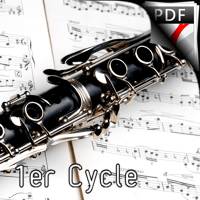







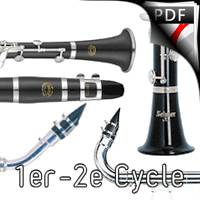
































The clarinet is a wind instrument with a single reed, a straight cylindrical tube with an almost cylindrical bore and a flared bell.
The word clarinet certainly comes from the Old French clarin or clarion, or from the Provençal clarinet "clarin" (oboe). However, it would seem that its true roots lie in the various names of the trumpets used during the Renaissance and Baroque periods. Clarion, clarin and the Italian clarino are all derived from the medieval term claro, which referred to a type of trumpet. This is probably the origin of the Italian clarinetto, itself a diminutive of clarino, and consequently of European equivalents such as the French clarinette or the German klarinette. According to Johann Gottfried Walther, writing in 1732, the reason for the name was that "it sounded like a trumpet from a distance". The English form clarinette was found as early as 1733, and the now archaic clarionet appeared from 1784 until the early years of the 20th century.
Although the similarity of sound between the first clarinets and the trumpet may indicate its name, other factors may have played a part. In the late Baroque period, composers such as Bach and Handel imposed new demands and skills on their trumpeters, who were often required to play difficult melodic passages in the high register. Since trumpets of this period had no valves, melodic passages often required the use of the highest part of the trumpet's range, where the harmonics were close enough to produce adjacent scales of notes. The trumpet parts that required this speciality were known as clarino and this applied to the musicians themselves. It has been suggested that clarinettists might have used it when playing particularly difficult scores on these newly-developed 'false trumpets'.
These days, the most popular clarinet is the Bb clarinet. However, the A clarinet, just a semitone lower, is commonly used in orchestral music. Since the mid-nineteenth century, the bass clarinet (now invariably in Bb but with extra keys to extend the range by a few notes) has become an essential addition to the orchestra. The clarinet has proved to be an exceptionally versatile instrument, both in the classical repertoire and in scores for wind bands, military bands, brass bands, klezmer and jazz.