


Scores Saxophone Grade 5 to 8
Sort by
Authors




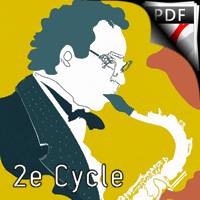
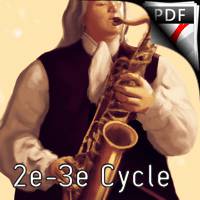

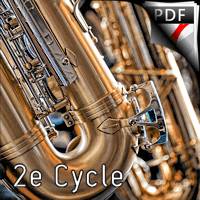
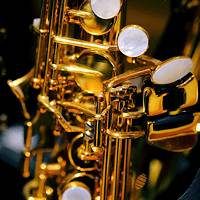


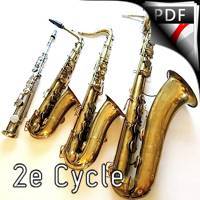
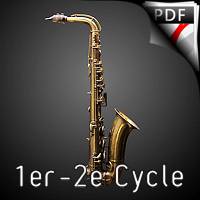









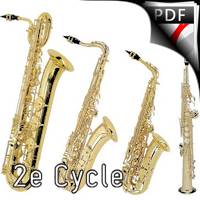
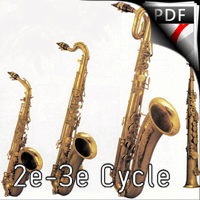




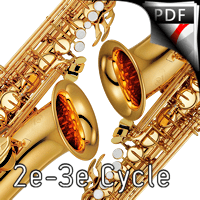

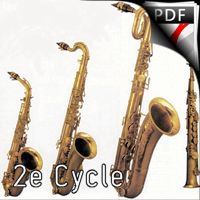

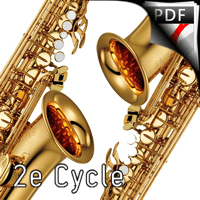

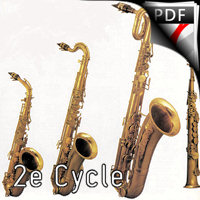
The saxophone was developed in 1846 by Adolphe Sax, a Belgian instrument maker, flautist and clarinettist. Born in Dinant and originally from Brussels, he moved to Paris in 1842 to set up his musical instrument business. Prior to his work on the saxophone, he made several improvements to the bass clarinet, improving its keywork and acoustics and extending its lower range. Sax was also a maker of the then-popular ophicleid, a large conical brass instrument in the bass register with keys similar to a wooden instrument. His experience with these two instruments enabled him to develop the skills and technologies needed to make the first saxophones. As an extension of his work on improving the bass clarinet, Sax began to develop an instrument with the projection of a brass instrument and the agility of a woodwind.
Sax created an instrument with a single-reed mouthpiece like a clarinet, a tapered brass body like an ophicleid, and some of the acoustic properties of a clarinet.
Having built saxophones of various sizes in the early 1840s, Sax applied for and was granted a 15-year patent for the instrument on 28 June 1846. The patent covers 14 versions of the basic design, divided into two categories of seven instruments each, ranging from the sopranino to the double bass. Although the instruments transposed to F or C are considered 'orchestral', there is no evidence that Sax intended to do so. As only three per cent of Sax's surviving output was set in F and C, and as contemporary composers have freely used the Eb alto and Bb bass saxophone in orchestral scores, it is almost certain that Sax experimented to find the most appropriate keys.
The saxophone gained popularity for one of the purposes for which it was designed: military bands. Although the instrument was mostly ignored in Germany, French and Belgian military bands took full advantage of the instrument Sax had designed. Most French and Belgian military orchestras incorporated at least one saxophone quartet, consisting of an Eb baritone, a tenor, an alto and a soprano. These four instruments proved to be the most popular of all Sax's creations, with the Eb contrabass, the Bb bass and the insufficiently powerful Eb sopranino. British military bands tend to include at least two saxophonists, the alto and the tenor. Today, the saxophone is used in military bands all over the world.
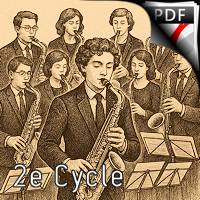
The saxophone was later introduced into wind band scores, which generally require an Eb alto saxophone, a Bb tenor saxophone and an Eb baritone saxophone. A Bb bass saxophone is called for in some pieces (particularly the music of Percy Grainger).
Saxophones are used in chamber music scores, such as saxophone quartets and other combinations of chamber instruments.
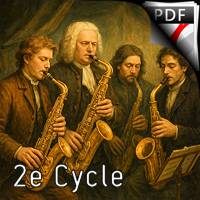
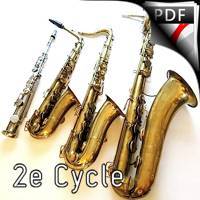
The classical saxophone quartet consists of a soprano saxophone, an alto saxophone, a tenor saxophone and a baritone saxophone. There is a repertoire of classical compositions and arrangements for SATB instrumentation dating back to the 19th century, notably by French composers who knew Sax. Among the classical saxophone quartets are the Habanera Quartet, the h2 Quartet, the Raschèr Saxophone Quartet, the Aurelia Saxophone Quartet and the New Century Saxophone Quartet. The quartets led by Marcel Mule and Daniel Deffayet, saxophone teachers at the Paris Conservatoire, were founded in 1928 and 1953 respectively, and enjoyed a great reputation. The Mule Quartet is often regarded as the prototype of future quartets, due to the level of virtuosity demonstrated by its members and its central role in the development of the quartet repertoire. However, organised quartets existed before the Mule ensemble, the first example being the quartet led by Eduard Lefebre (1834-1911), a former soloist with the Sousa group, in the United States. 1904-1911. Other ensembles probably existed at this time as part of the saxophone sections of the many professional touring bands that existed in the late 19th and early 20th centuries.
In the twentieth and twenty-first centuries, the saxophone found increasing popularity in symphony orchestras. In one size or another, the instrument has also been found to be a useful accompaniment to genres such as opera and choral music. Many musical theatre scores include parts for a saxophone, sometimes doubling another wind or brass instrument. In this way, the saxophone acts as an intermediary point between the other woodwinds and the brass section, helping to blend them together.